Note: All student names and identifying details have been changed.
A Sought-After Pig
“WHERE IS PEPPA PIG” my students seemed to be collectively shouting.
“THIEF! THIEF! THERE’S A THIEF!” someone yelled.
I have learned that I can never predict how my in-class activities will unfold, but even I had to step back and wonder.. How the heck did I end up teaching a class where Peppa Pig is a highly sought-after item, and not only that, she has now gone missing while my students were attending a wedding.
I reminded them, we are part of a society that uses collective decision-making, so what will you all collectively decide to do?
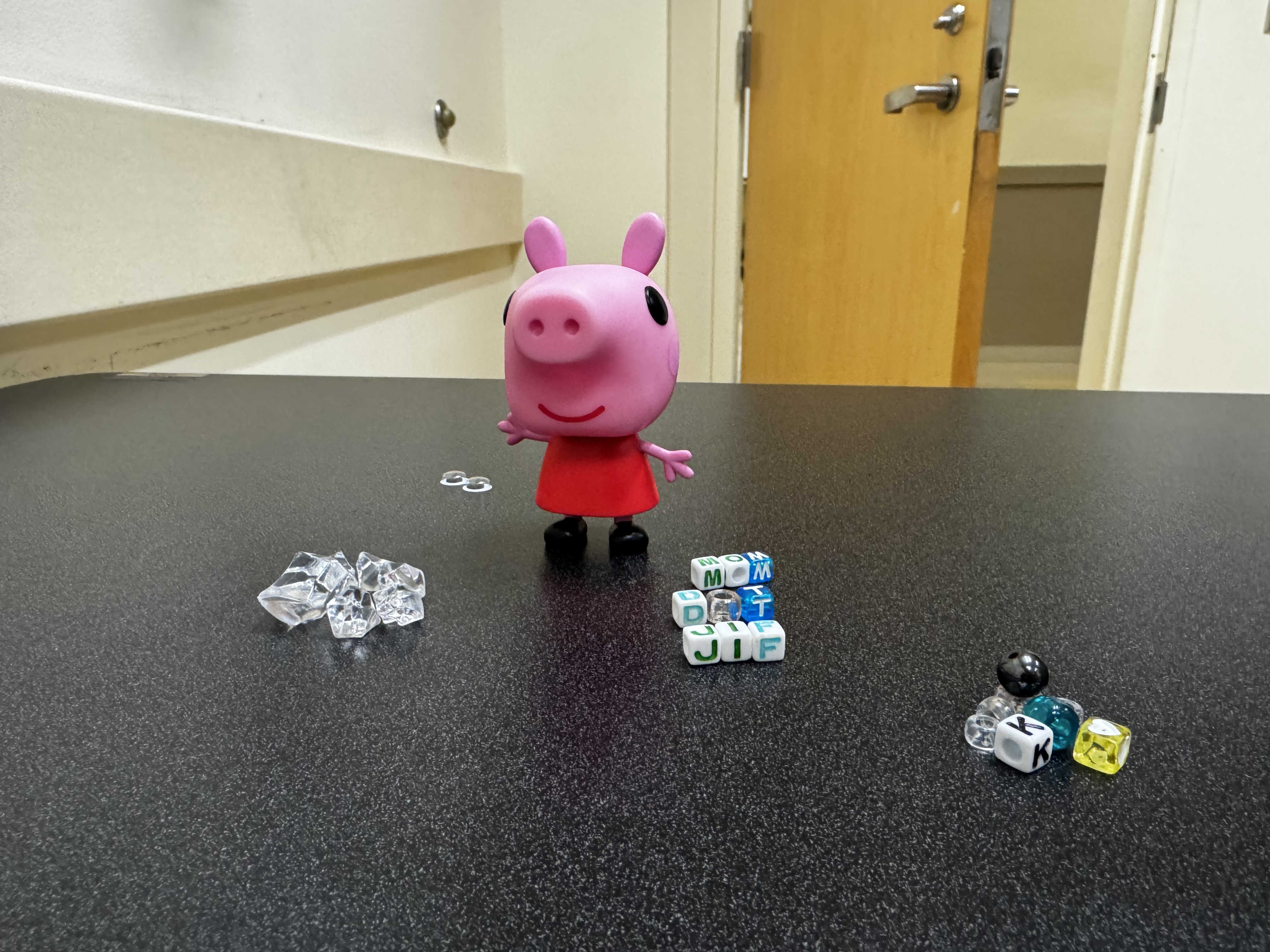
When class began that morning, I did not think they could have predicted this moment either. I arrived to class slightly early, carrying a bright green basket to match my completely green outfit. The students are always instantly intrigued when they see me carrying items in. They know I am up to something.
I grabbed a few rubber ducks and waltzed around to the three students that were already in the room. I set a duck down on Finn’s desk.
“Here is a gift! It is from me to you. You’re welcome!!”
He seemed delighted, but confused. He knew better than to ask questions. My students learn quickly that when I am being vague, it’s on purpose.
As more students arrived, I was either at my desk, meeting them at the door with small gifts. Or I’d bring them to their desks after they sat.
I gave students various amounts of resources. Some were given large amounts of beads (food), some given just a few, some given, well, none. I gave one student a giant pile of plastic diamonds, then waltzed around giving a few other students small amounts. One student, Jules, received only two diamonds and no other resources.
I gave a few students string, to represent influence they have on social relations, a few were given plastic needles to represent craftsmanship, and just two were given plastic flowers to represent medicine.
I also threw in random items to be silly. There was a small plastic dinosaur and a flamingo among those items. When a student asked me what the flamingo represented, I bluntly replied, “A flamingo. You have a flamingo.”
As they were waiting for class to begin, still without any context of why they were given these gifts, the students were already discussing who had what. Some were complaining they didn’t have ducks. Some didn’t understand why Mara had so many diamonds and all they had was two beads.
While the students discussed, I quietly brought Peppa Pig over to Sol and set it on his desk. I let him know Peppa held a lot of importance within our society and that he was the only one being gifted her. Some students noticed in that moment that Peppa was in the room. Most noticed over time.
I started class by clearly and intentionally ignoring their questions on their gifts, giving them blunt and vague answers. A student who had walked in late raised her hand to point out she hadn’t been given a gift yet.
“Ah, well, hopefully one makes it your way,” I said, and immediately began my brief lecture.
Can You Name a Truly Free Gift?
I gave my students the basic framework of Marcel Mauss’s theory on The Gift. I didn’t go too deep with it, as the students were about to live the theory in real time. Instead, I let them lead the conversation with me facilitating.
Of course, I posed the classic anthropology professor question:, “Well, can you give me an example of a free gift?”
They instantly start shouting the classic responses – “Charity!” “When I buy my friend dinner.” “Oh, well, my mom doesn’t expect anything from me!”
I reminded them that reciprocation isn’t always immediate and it isn’t always something physical.
I went over the concept of social currency one last time then lead right into the activity. I explain all the gifts they had received were the foundation for several rounds of mock gift giving. I walk them through each resource, explaining their importance. I hear more complaints from students who were not gifted tiny rubber ninja ducks.
Gift Giving.. or Something Like It..
For their first round of gift giving, I explained, each of them was required to give a gift to another classmate.
They could give as little or as much as they wanted. Not everyone needed to receive a gift, but everyone had to give one. They sat there awkwardly for a moment, as students do when faced with unfamiliar activities. But, it didn’t take long for the hustle and bustle to begin.
Later in class, I walked around to join their conversations as they were gifting. For the first round, I stepped back and observed..
Just as I suspected, I started hearing a word that should not be part of a gift giving activity.
Trade.
I let it happen for a moment.
“I’ll trade you my beads for that string,” I heard from Javi. He wanted the string so bad.
“I’ll trade you three diamonds for a duck,” I heard another student say.
Finally, I dramatically chimed in. I threw my hands up.
“Wait wait wait, what are you all doing?”
They all looked collectively confused. The class, in agreement insisted they were doing as I instructed.. they were gifting.
So I asked, “Then why do I keep hearing the word trade?”
From collective confusion, to collective shock. I asked them to sit so we could discuss. “Why did this happen?” I ask?
Finn raises his hand and says, “Well, I think we are just so used to it working that way. You give something, you get something”
The rest of the class begins to agree. They confess variations of the same realization: they had defaulted to trade without even thinking about it.
Ah yes.. you are witnessing the power our cultural norms have in action, right here in class.
Gift Economy (Try Again)
So now it’s time for the next round of gift giving. I told the students same rules as before. I make sure though, to overemphasize.. Absolutely no trading.
This round is smoother, the students (mostly) do as instructed. They seemed pleased with their gifts and with each other.
I check on the room after.
“Who feels wealthy?” I ask. A few students raise their hands.
“Who feels poor?’ I ask. A few more than before raise their hands.
“Who feels somewhere in the middle?” The majority of the class raises their hands.
I then ask, “Who received more than two gifts during the last round?” About five students raise their hands.
“Okay,” I start to explain, “for this round: if you received two gifts last round, you must now give out three gifts. If you received three or more, you must give out five.”
The students, who looked so pleased just moments ago to share that they received many gifts, now looked very upset with me.
“You clearly have social favor,” I told them. “Because of this, you received more gifts. Since you received so much, shouldn’t you share with your peers?”
Jules was very upset. If you remember, he began class with just a few diamonds, not even food. He finally had food, but only because he received multiple gifts.
“I have a lot!” He exclaimed, “But that doesn’t mean I have a lot to give!”.
I checked in on the room again. “How is everyone feeling?”
The same mixed reactions as before: some were overjoyed, some were very annoyed, others still didn’t understand why they didn’t get a duck.
“Those of you I gave ducks to, how did it feel when I gave you a duck? Especially when you noticed I wasn’t giving anyone else ducks?”
“I felt special!” exclaimed Finn.
“I felt suspicious,” said Reed.
“Ah, interesting,” I reflected. Then immediately moved to the next round.
I call on a random student and ask them to pick a number between one and six. They picked four.
“Okay,” I said, and began counting the rows “one… two… three… four… five… six…
Disaster Strikes Row Four
Then I walked up to row four with my cup and informed the students, very solemnly – that their village had suffered a fire and all of their homes were completely lost.
I began walking down aisle four scooping their resources from their desks into my cups.
Javi looked absolutely crushed when I scooped his string from him.
After proudly showing off the overfilled cup of resources, a student raised their hand to inform me I had forgotten a bead on her desk.
“When I was a kid,” I told them, “A restaurant in my town burned down. My dog dug up and brought home an entire burnt chicken from the rubbage.”
“That bead is your burnt chicken.”
I did feel bad for the students who lost all of their belongings. So, for the next round of gift giving, I let the class know they had option to gift to those who lost their resources in the fire, but it was not required.
Most of the class stood up to help.
A few students, though, sat back down. After observing how much they had received. They’d been given enough – the students seemed to have decided.
Mara, the student who received the large pile of diamonds at the beginning of class and was still the wealthiest in the room, looked at me and bluntly said:
“I’m not giving them anything, I gotta hold onto what I got.”
I sat there for a moment continuing to observe and I reflected on what she said.
It wasn’t just that she made the decision to not gift those in need. It was that she wanted me to know she made that choice.
By this point, the class had been through a lot.
Time for a wedding!
I inform the class that one of them is getting married. Many students volunteered, but I chose Mara, our wealthiest student.
You’re Invited (But Bring a Gift)
“Okay,” I said. “Mara is getting married in 30 seconds. The entire class is invited and you must show up promptly, and well dressed to her desk to drop off your wedding gifts.
Once again, the frustration in the room was very clear to me.
They lined up and began dropping off their wedding gifts.
Not only were they being forced to gift for a special occasion, but as they are doing so, they are seeing up close how large her growing pile is.
The students at the end of the line seemed the most visibly bothered by this.
Once everyone was seated, I again began checking in on how they were feeling.
That’s when I heard Ezra.
“WHERE IS PEPPA PIG?”
The class broke out into chaos.
By now, most students had learned of Peppa Pig’s circulation, but she was moving between owners almost silently.
There had been little fuss or discussion of her up until this moment, but clearly, there was a thief.
Once the chaos begins to settle, I break into the conversation.
“Okay… so.. where exactly is Peppa Pig?”
Jules, grinning slyly, slowly lifts Peppa Pig into the air.
Chaos breaks out again.
“Jail!”
“Exile!”
“Charge him a fine!”
“Repossess his resources!”
I reminded the class that we are a society built on collective decision-making. It was their responsibility, as a group, to decide what should happen to our thief.
Their society. Their Rules. A thief to deal with.
I was staying out of it.
Jules tries to explain.
He talks about concerns of his poverty, the lack of gifts given to him, how he was ignored.
The chaos drowns out his pleads.
The class settles on exile.
Justice Served, Kinda
I stride over to the door, open it, and motion my arms while staring at the student.
“So sorry.”
I held the pose for a moment as the students burst into laughter.
“Nah, I’m messing,” I told him.
The students though had already moved onto the next concern.
What Happens to Peppa?
I reminded them: use collective decision making.
Some students wanted to vote for a new owner. Others wanted to give it back to the original owner from the beginning of class.
Ultimately, they agreed on returning it to its last rightful owner.
Ezra was very pleased.
It took me a moment to settle the excitement.
Once I regained their attention, I let them know:
Time For a Celebration.
“We have been blessed with a bountiful harvest this year!” I exclaimed. “To celebrate, the newlywed couple will be hosting a feast and you all are invited!”
I took paused to explain the concept of wealth redistribution.
I then told the students that when they attend the feast, Mara will give each of them three gifts. Then, without another word, I took my cup of resources and dumped it onto Mara’s desk.
“In addition, your deity has blessed the couple with bountiful resources!”
So now, in addition to the massive wealth she started with, the random gifts she had received, and the forced gift giving during the wedding – Mara had a pile larger than the rest of the class combined.
Redemption Duck
I stepped back and watched as the students lined up to attend the feast.
Mara became unexpectedly generous. She was only required to give three gifts, but I saw her giving upwards of ten. Grabbing piles without even counting, giving freely.
I heard Finns excitement over receiving another duck. I heard students whispering to each other about how kind she was.
The atmosphere felt joyous.
I asked the students how they felt about their experience.
As I suspected, Finn spoke right up.
“She gave me a duck! It made me have really positive emotions about her! I love the ducks!”
“Yeah! She gave me so much food and diamonds,” said another student. “I don’t feel poor anymore.”
I reminded them of their frustration over her wealth during her wedding.
The class all seemed to agree..
Her generosity had redeemed her.
“Is it okay that she has so much more, though?”
They didn’t seem to care.
Now it was time to pick a winner. The person the class believed had collected the most social currency.
I told them, this person will be our Elder in our next activity.
The students started shouting names.
I settle them and then take a moment to discuss what social currency really means.
Choosing the Elder
I ask them:
“Who do you feel acted with the most social grace?”
“Who do you think was the kindest?”
“Who was the most thoughtful. The most mindful?”
Their answers suddenly changed.
We are down to Ellis and Javi.
Then chaos breaks out again.
“BUT JAVY WAS TRADING THE ENTIRE TIME EVEN THOUGH YOU TOLD US NOT TO! PEOPLE JUST SAY HIM BECAUSE HE MAKES THEM LAUGH”
The class disqualifies Javi.
After some more discussion, they decided Ellis should be the winner of who has the most social currency.
Everyone starts sharing stories about her kindness: how she was checking on others, how she gifted those in need, never expecting anything in return.
Ah, we are in agreement, I thought.
Until Sol raised his hand.
“Professor… I don’t really want to say this. But I have to be completely honest with you.
I don’t think it should be Ellis, I think it should be Mara.
She has the most resources.”
The rest of the class started nodding. Then, agreeing. Loudly.
There it is, I thought.
You did it, you recreated capitalism.
You unknowingly allowed someone to hoard resources, resented her when you realized, were forced to give her more.
But now?
You want to put her in a position of power because she was nice to you at the feast?
Even though her redistribution was forced?
“Well, she has resources. We need them. That’s why she should have a position of power.”
I thought back to when she told me that she had no interest in helping after Row Four lost everything in a fire.
“How do we even know she will share those resources?” I asked the class.
I brought them back to the beginning of class and referenced how quick they reverted to trading when asked to gift.
I asked them if they thought it happened again here.
Then I let them sit with it for a moment.
They’d been through enough at this point.
“So, what about Peppa then, I ask to break the silence, where did she end up?”
Zora stood up, holding Peppa. She was so proud and pleased with herself.
Other students murmured that they wished they had Peppa Pig.
I threw my arms up and started jumping around.
“PEPPA PIG IS A CURSED OBJECT! SHE HAS BEEN TRAVELING THROUGH VARIOUS LINEAGES FOR CENTURIES, WITH EACH FAMILY TRYING TO EXPEL THE HOLD SHE HAS OVER THEM. THE CURSE TAKES EFFECT WHEN YOU ARE GIFTED HER, SO NO ONE EVER TELLS YOU SHE’S CURSED. NEXT CLASS, THE CURSE WILL TAKE HOLD. HAVE A GREAT DAY. SEE YOU THURSDAY!”
Peppa’s Legacy
The following class felt just as brilliant, perhaps even more so. We finished the activity, but the real focus was the student-led discussion reflecting on it all.
I couldn’t believe it as I stood there watching not only how engaged they were, but they were articulating anthropological theory I hadn’t even taught them yet. I only had to speak up to fill in missing terminology.
I shared with them some of my own observations from the previous class. I made sure to include the fact that Mara had refused to give during the fire. The class was shocked.
Then I revealed the final twist: Peppa Pig’s cursed traveling through the process of gift giving. Those with the curse would have unwanted attention and envy.
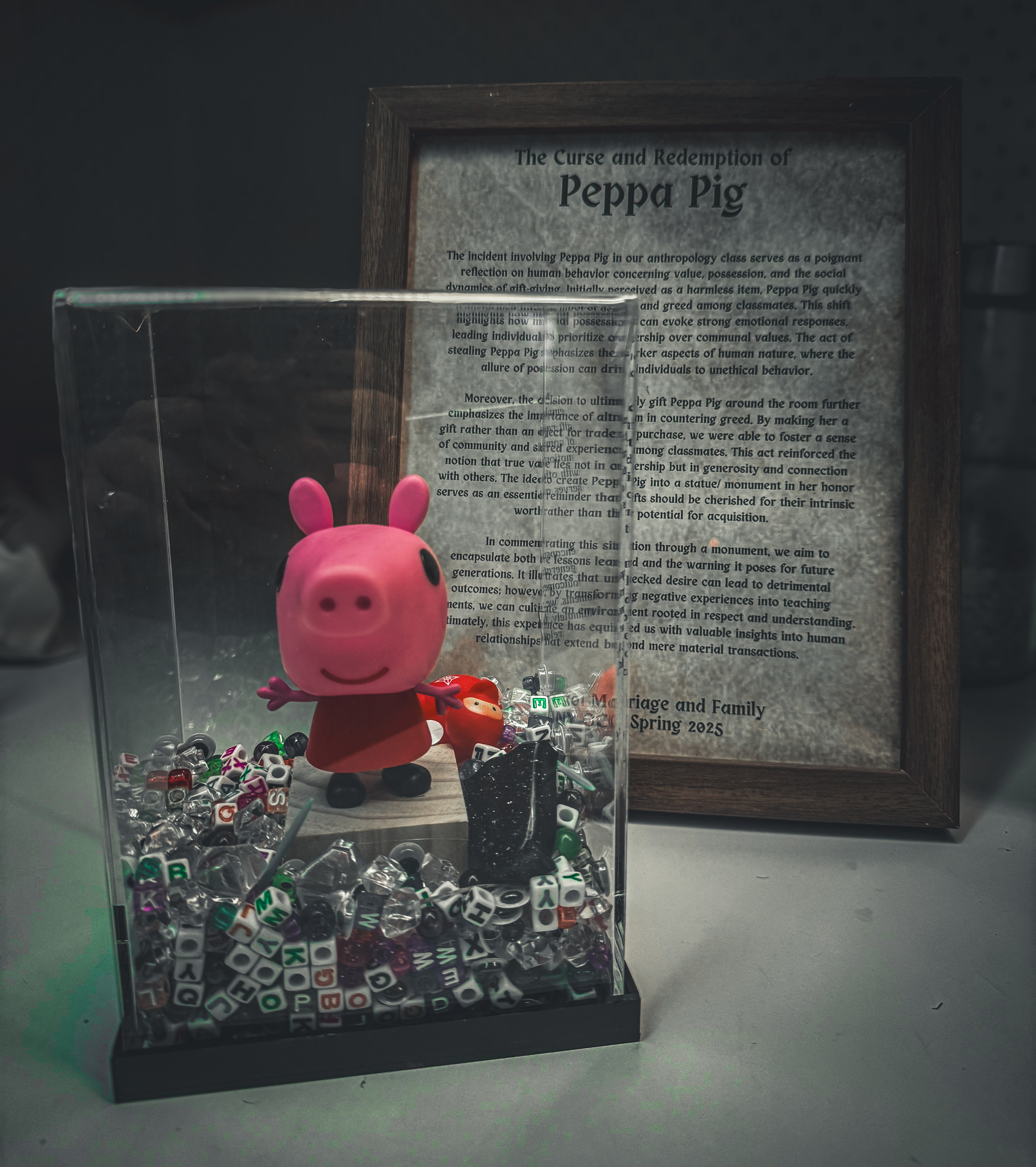
I gave them four options for what to do with her, presented in a very serious, very silly PowerPoint. Our Elder, Ellis, made the final decision after allowing the class to share their thoughts on the matter. She let us all know that Peppa would be enshrined to warn future generations. She would be sealed away to protect us from her influence.
Zora, as the final curse-bearer, was invited to write whatever she wanted to label the shrine with. She ended up creating a full piece of lore – detailed, rich, thoughtful, hilarious.
Over spring break, I printed her text, put together a shrine, and brought it to class. The students were overjoyed and signed the piece of lore.
Peppa Pig and her curse are officially sealed away.
For now.
 Chelsz
Leave a comment